Automating Your Finances: The Ultimate Guide to Set-It-and-Forget-It Savings
Stop stressing over missed bills and empty savings. Learn how to put your entire financial life on autopilot with simple, actionable steps to automate your savings, bills, and investments. Get your money working for you while you sleep.

The Secret to Financial Peace of Mind
Picture this: It's a beautiful Saturday morning. It's a crisp 68 degrees Fahrenheit outside, the sun is shining, and you're sipping your coffee without a single worry in the world. You aren't frantically logging into three different bank apps. You aren't wondering if you paid the electric bill. You aren't feeling that familiar knot of guilt because you promised yourself you'd transfer money into savings this month, but somehow it all evaporated into a series of $15 DoorDash orders and a "quick" Target run that ended up costing $142.
Financial stress is one of the biggest enemies of overall wellness. At Onyx Sound Lab, we talk a lot about finding your frequency and achieving mental clarity, but let's be real—it's incredibly hard to meditate or relax when you're stressed about money.
The good news? You don't need to be a Wall Street whiz or have superhuman willpower to build wealth and pay your bills on time. You just need a system.
Welcome to the magic of financial automation. By putting your finances on autopilot, you remove human error, eliminate decision fatigue, and guarantee that your money goes exactly where it needs to go. Here is your step-by-step guide to setting up a "set it and forget it" financial life.
Phase 1: Establish Your "Grand Central Station"
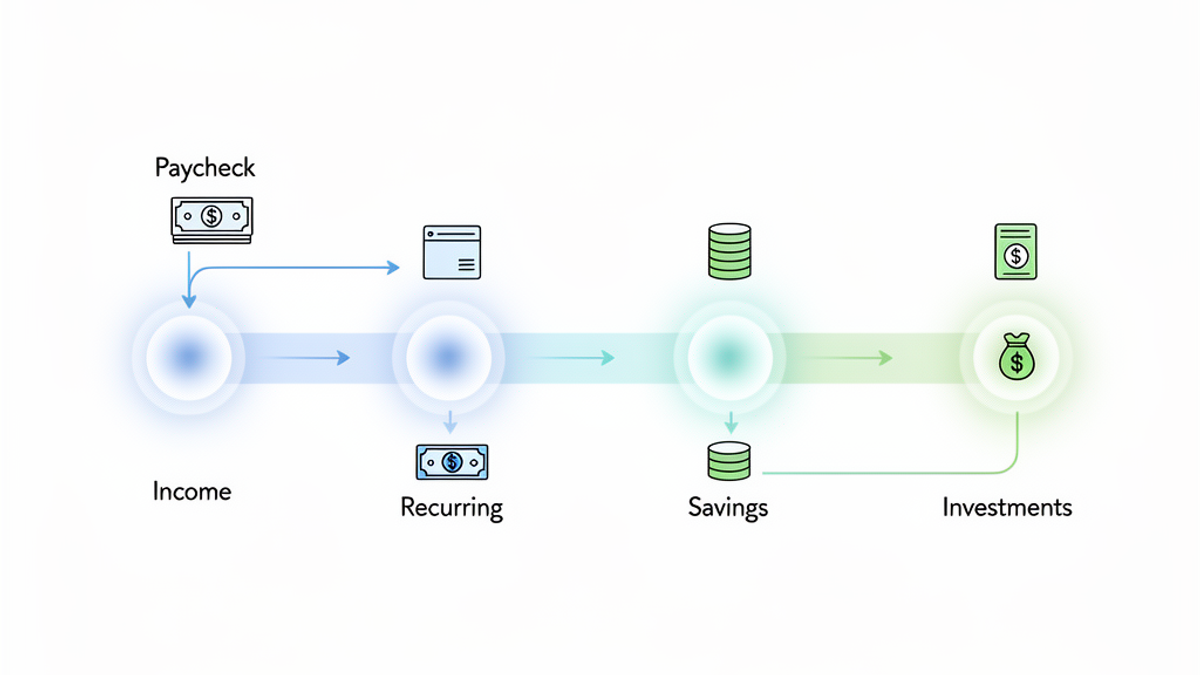
To automate your finances, you need a hub. For most of us, this is our primary checking account. Think of this account as Grand Central Station. Money arrives here, but it doesn't stay here. It gets routed to different destinations automatically.
Step 1: Direct Deposit is Your Best Friend
If you haven't already, set up direct deposit with your employer. Waiting for a paper check, driving three miles to the bank, and waiting in line is a waste of your precious time.
Pro Tip: Many employers allow you to split your direct deposit right at the payroll level. You can ask HR to send 80% of your paycheck to your checking account and 20% directly to a high-yield savings account. If you can do this, you've already won half the battle, because you literally never see the savings money in your checking account to begin with.
Phase 2: Pay Yourself First (The Golden Rule)
Most people pay their bills, buy their groceries, spend money on fun stuff, and then try to save whatever is left over at the end of the month. Spoiler alert: There is rarely anything left over.
Automating your savings flips this script. You save first, automatically, and live on the rest.
Step 1: Open a High-Yield Savings Account (HYSA)
If your savings account is at a traditional brick-and-mortar bank earning 0.01% interest, you are losing money to inflation every single day. Open an online HYSA (places like Ally, Marcus, or Capital One are great options). They typically offer interest rates that are significantly higher—meaning your money makes money just by sitting there.
Step 2: Set the Automatic Transfer
Log into your checking account and set up a recurring transfer to your HYSA. Schedule this transfer for the exact same day you get paid.
Start with a specific, manageable dollar amount. Let's say you get paid every other Friday. Set up an automatic transfer of just $75 per paycheck. That's $150 a month. Over a year, that's $1,800 saved without you lifting a finger. Bump that up to $200 a paycheck, and you're saving $4,800 a year.
Suddenly, when your car needs new brakes or you need to make an emergency run to Home Depot because your water heater exploded, you have the cash ready. No panic, no credit card debt.
Phase 3: Crush Your Bills on Autopilot
Late fees are a completely avoidable tax on the disorganized. By automating your bills, you protect your credit score and keep more money in your pocket.
Fixed Bills vs. Variable Bills
Fixed bills are the same amount every month: rent or mortgage, car payments, internet, gym memberships, and streaming services.
Variable bills fluctuate: electricity, water, credit card bills.
How to Automate Them
- Use a Credit Card for Everyday Bills: Whenever possible, set up your fixed bills to auto-pay from a rewards credit card. This protects your checking account from direct vendor withdrawals and earns you points or cash back.
- Direct Bank Auto-Pay for the Big Stuff: For things that charge a fee to use a credit card (like rent or a mortgage), log into your bank's portal and use their "Bill Pay" feature to push the money to the vendor a few days before the due date.
- Buffer Your Checking Account: Because variable bills change, keep a buffer of $200 to $500 in your checking account so an unexpectedly high winter heating bill doesn't trigger an overdraft fee.
Phase 4: Tame the Plastic (Credit Card Automation)
Credit cards are fantastic tools for fraud protection and rewards, but they are absolutely toxic if you carry a balance. The average credit card interest rate in the US is hovering around 24%. You cannot build wealth if you are paying 24% interest on a Walmart grocery run from three months ago.
The "Statement Balance" Hack
Log into your credit card app right now. Go to the Auto-Pay settings. You will see a few options: Minimum Payment, Fixed Amount, or Statement Balance.
Always select Statement Balance.
By automating the payment of your full statement balance every month, you will never pay a single dime in interest. Period. Schedule the auto-pay for 3 to 5 days before the actual due date to give the funds time to clear.
Phase 5: Future-Proofing (Automating Investments)
Saving money keeps you safe; investing money makes you wealthy. The beauty of the stock market is compound interest, and the best way to harness it is through consistent, automated contributions—a strategy known as Dollar Cost Averaging.
The 401(k) Match: Free Money
If your employer offers a 401(k) match, this is your first and most important investment. If they match up to 5% of your salary, you need to go into your benefits portal and set your contribution to at least 5%. This money is pulled from your paycheck pre-tax, meaning you barely feel the pinch, and you are instantly getting a 100% return on your investment thanks to the employer match.
The Roth IRA: Tax-Free Growth
Once you have your 401(k) match, open a Roth IRA with a brokerage like Fidelity, Vanguard, or Charles Schwab. Set up an automatic monthly transfer from your checking account into the Roth IRA.
Crucial Step: Don't just transfer the money; make sure you automate the investment. Set your account to automatically buy a broad-market index fund (like an S&P 500 fund) with that money. Even $100 a month invested in the market can grow into hundreds of thousands of dollars by the time you retire.
Phase 6: Guilt-Free Spending
Once you have automated your savings, your bills, your credit card payments, and your investments, what happens to the money left in your checking account?
It's yours to spend. Guilt-free.
This is the psychological brilliance of automation. You don't need to meticulously track every penny you spend on a spreadsheet. If you want to Venmo your friend for concert tickets, Zelle your sibling for a shared gift, or buy a ridiculously oversized TV at Costco, you can do it with zero guilt.
You already paid your future self. You already paid your bills. The money left over is your allowance. Enjoy it.
What About Freelancers and Gig Workers?
If your income fluctuates because you're a freelancer, a server, or a gig worker, automation is a little trickier, but still entirely possible.
Instead of automating fixed dollar amounts, automate percentages. Many modern banking apps and fintech tools allow you to set rules. For example, you can set a rule that says, "Every time a deposit hits this account, transfer 20% to my tax savings account, and 10% to my emergency fund." This ensures that whether you make $500 or $5,000 in a given week, your savings scale appropriately.
The Monthly 15-Minute Check-In
"Set it and forget it" doesn't mean "ignore it forever." Automation is like a self-driving car; it does 99% of the work, but you still need to keep your eyes on the road.
Schedule a 15-minute date with your money once a month. Grab a coffee, open your laptop, and just look things over.
- Did all the transfers go through?
- Are there any weird fraudulent charges on your credit card?
- Are there subscriptions you forgot about that you can cancel?
This 15 minutes of light maintenance will keep your automated machine running smoothly year-round.
Your Actionable Takeaway: Do This Today
Reading about automation won't save you money; taking action will. Don't try to set up this entire system in one day, or you'll get overwhelmed.
Here is your specific, actionable step to take right now: Choose just one savings goal. Log into your banking app today and set up a recurring, automatic transfer of $50 from your checking account to your savings account. Schedule it to happen the day after your next payday.
It will take you less than three minutes. You probably won't even miss the $50. But in a few months, you'll look at your savings account, see hundreds of dollars sitting there that you didn't have to stress over, and you'll realize the incredible peace of mind that comes with putting your money on autopilot.

SunMaster USA
Editorial Team
The SunMaster USA team finds, tests, and shares the smartest lifehacks, money moves, and home improvement tips that make everyday life easier for American families.