Coffee at Home: How to Make Café-Quality Drinks and Save $1,500/Year
Skip the daily drive-thru and keep $1,500 in your pocket this year. Learn how to brew café-quality coffee at home using affordable tools like a French press, AeroPress, or a simple Mason jar. Your mornings are about to get a major upgrade.

The Morning Ritual (and The Painful Math)
At Onyx Sound Lab, we talk a lot about frequencies, soundscapes, and setting the right tone for your nervous system. But let's be real: for most of us, the day doesn't actually start until that first cup of coffee hits. The morning coffee ritual is a powerful grounding practice. The rhythmic hum of the grinder, the soothing trickle of hot water, the rich aroma filling your kitchen—it's a sensory experience that wakes up your brain long before the caffeine actually kicks in.
But somewhere along the line, we outsourced this beautiful morning ritual to the drive-thru. We started hopping in the car, driving three miles out of our way, sitting in a line of idling cars, and paying a premium for a paper cup. Or worse, we open DoorDash, pay a delivery fee, a service fee, and a tip, turning a morning pick-me-up into a massive financial leak.
Let's do the painful math. A standard iced latte or cold brew at your local Starbucks or neighborhood café runs about $5.50 these days. Add a $1 tip, and you're at $6.50 a day. If you do this just five days a week before work, that's $32.50 a week, or roughly $1,690 a year.
Now, let's look at your kitchen. If you buy a premium bag of whole beans from a local roaster—or grab a massive, high-quality bag from Costco for $18—your cost per cup drops to about $0.50 to $0.80. Even if you drink it five days a week, you're spending maybe $200 a year.
That is a net savings of nearly $1,500 a year. That's a vacation. That's maxing out a chunk of your Roth IRA. That's a beautiful new piece of furniture. And the best part? With a little bit of knowledge and some basic gear you can grab at Target or Walmart, your home-brewed coffee will actually taste better than the rushed cup you get from the drive-thru.
The Foundation: Beans, Water, and Grind
Before we talk about the gear, we have to talk about the ingredients. You can't make a Michelin-star meal with gas station sushi, and you can't make café-quality coffee with stale, pre-ground beans that have been sitting on a grocery store shelf since the Bush administration.
1. Buy Whole Beans
Coffee beans are like little flavor vaults. The moment you grind them, they start losing their complex aromas and flavors due to oxidation. To get café-quality coffee, you need to buy whole beans and grind them right before you brew. Look for bags that have a "Roasted On" date rather than an "Expiration" date. You want beans that were roasted within the last two to four weeks.
2. Get a Burr Grinder
If you're going to invest money anywhere, put it here. Blade grinders (the ones that look like little blenders) chop your coffee beans into uneven chunks—some boulders, some dust. This leads to bitter, muddy coffee. You want a "burr grinder," which crushes the beans into a uniform size. You can find a solid entry-level burr grinder from brands like Cuisinart or OXO at Target or Walmart for around $40 to $60. It will pay for itself in a month.
3. Mind Your Water
Coffee is 98% water. If your city tap water tastes like a swimming pool, your coffee will taste like a swimming pool. Use filtered water from your fridge dispenser or a Brita pitcher. When boiling, aim for about 200°F (93°C). If you don't have a fancy thermometer kettle, just bring your water to a rolling boil and let it sit off the heat for about 30 seconds before pouring.
The Gear: No $1,000 Espresso Machine Required
You don't need a massive, stainless-steel espresso machine taking up half your kitchen counter to make incredible coffee. The best brewing methods in the world are entirely manual, incredibly cheap, and take up very little space. Let's break down the “Big Three” manual brewers.
Method 1: The French Press (Rich, Bold, and Foolproof)
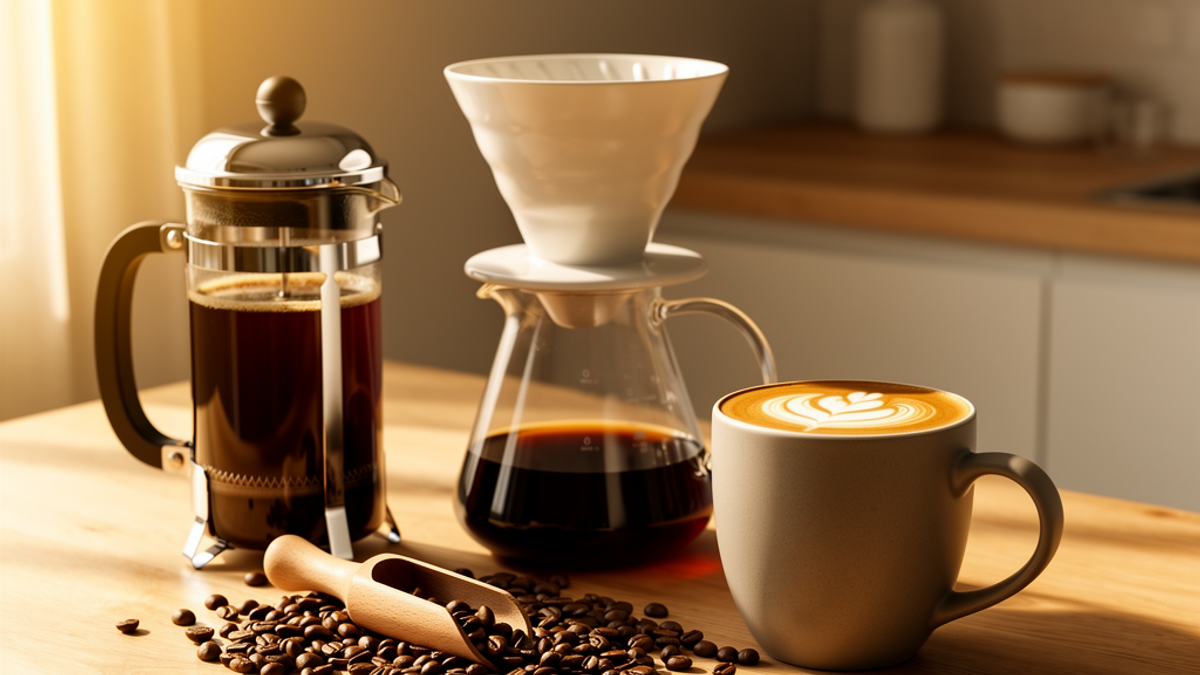
The French press is the undisputed heavyweight champion of home coffee. It produces a full-bodied, rich, and oily cup of coffee because it doesn't use a paper filter to strip away the natural coffee oils. You can pick up a glass Bodum French press at Target for about $20.
How to Brew It:
- The Grind: Coarse (think the texture of sea salt).
- The Ratio: 1 part coffee to 15 parts water. (e.g., 30 grams of coffee to 450 grams of water).
- Step 1: Add your coarse coffee grounds to the bottom of the empty press.
- Step 2: Pour your 200°F water over the grounds, ensuring they are all saturated. Give it a gentle stir with a wooden or plastic spoon (metal can crack the glass).
- Step 3: Put the lid on, but do not press the plunger down yet. Set a timer for exactly 4 minutes.
- Step 4: When the timer goes off, slowly press the plunger all the way down.
- Step 5: Pour immediately. If you leave the coffee sitting in the press, it will continue to over-extract and get bitter.
Method 2: The Pour-Over (Clean, Crisp, and Mindful)
If the French press is a heavy winter coat, the pour-over is a crisp linen shirt. Using devices like a Chemex, a Hario V60, or a simple ceramic cone you can buy at any home goods store, this method uses a paper filter. The result is a highly caffeinated, incredibly clean cup where you can actually taste the subtle flavor notes of the bean—like chocolate, blueberry, or jasmine. It's also the most "zen" way to make coffee.
How to Brew It:
- The Grind: Medium (think the texture of regular sand).
- The Ratio: 1 part coffee to 16 parts water.
- Step 1: Place your paper filter in the cone and rinse it with hot water. This removes the papery taste and pre-heats your mug. Dump the rinse water.
- Step 2: Add your coffee grounds.
- Step 3: The Bloom. Pour just enough hot water to wet the grounds (about twice the weight of the coffee). You will see the coffee bubble and expand. This is the "bloom," where the beans release trapped carbon dioxide. Let it sit for 45 seconds.
- Step 4: Slowly pour the rest of your water in gentle, concentric circles. A gooseneck kettle helps immensely here, giving you control over the flow rate. The whole process should take about 3 minutes.
Method 3: The AeroPress (Quick, Versatile, and Indestructible)
Invented by the same guy who invented the Aerobie flying ring, the AeroPress looks like a giant plastic syringe. It costs about $35 to $40, is virtually indestructible (making it perfect for camping or throwing in a suitcase), and brews a remarkably smooth, low-acidity cup of coffee in under two minutes.
How to Brew It:
- The Grind: Medium-fine (slightly finer than pour-over, but not as fine as espresso).
- The Ratio: 1 scoop of coffee (using the included scoop) to water filled up to the "4" mark.
- Step 1: Put a paper micro-filter in the cap, twist it onto the chamber, and place it over a sturdy mug.
- Step 2: Add your coffee grounds.
- Step 3: Pour hot water up to the top mark. Stir for 10 seconds.
- Step 4: Insert the plunger and gently press down. The air pressure forces the water through the grounds, creating a clean, concentrated brew.
The Secret to Café Drinks: Faux Espresso & Milk Frothing
What if you don't want a standard cup of black coffee? What if you want a vanilla latte, a cappuccino, or a flat white? You might think you need a $600 Breville machine with a steam wand to achieve this. You don't.
Making Faux Espresso
You can create a highly concentrated "espresso-like" shot using your AeroPress. Simply use a very fine grind, double the amount of coffee you normally use, and only fill the water up to the "1" or "2" mark. Press hard. You'll get a thick, rich concentrate that serves as the perfect base for milk drinks.
Frothing Milk Like a Pro
Cafés use expensive steam wands to create "microfoam"—that glossy, velvety milk texture that makes a latte feel luxurious. You can replicate this at home using two incredibly cheap methods:
The Handheld Wand: For about $12 to $15 on Amazon or at Target, you can buy a battery-operated milk frother. Heat your milk in the microwave for 45 seconds (or in a saucepan on the stove), submerge the wand just below the surface of the milk, and turn it on. In 20 seconds, you'll have a thick layer of foam.
The French Press Hack: This is an industry secret and arguably better than the electric wand. Heat your milk and pour it into a clean, empty French press. Insert the plunger and vigorously pump the mesh screen up and down through the milk for about 15 seconds. The mesh agitates the proteins in the milk, creating a dense, creamy microfoam that is actually good enough to pour latte art with. Pour this over your AeroPress "espresso" shot, add a pump of vanilla syrup (which you can buy at Walmart for $4), and you have a $6 latte for about 60 cents.
The Summer Lifesaver: Mason Jar Cold Brew
When the temperature hits 85°F in July, nobody wants to stand over a steaming kettle. You want cold brew. Cafés charge an absolute premium for cold brew because it takes time to make, but the actual labor involves almost zero effort.
All you need is a 32oz wide-mouth glass Mason jar (you can buy a 12-pack at Home Depot or Walmart for $15) and some coarse ground coffee.
How to Brew It:
- The Ratio: 1 part coarse ground coffee to 4 parts cold, filtered water. (This makes a concentrate).
- Step 1: Put 1 cup of coarse ground coffee into the bottom of the Mason jar.
- Step 2: Fill the jar to the top with 4 cups of cold, filtered water. Give it a good stir so all the grounds are wet.
- Step 3: Put the lid on and stick it in your fridge.
- Step 4: Wait. Let it steep for 12 to 18 hours.
- Step 5: Strain the mixture. You can pour it through a regular kitchen strainer lined with a paper coffee filter, or use your French press to filter out the grounds.
What you have now is cold brew concentrate. It is basically rocket fuel. Do not drink it straight unless you want to see sounds. To serve, fill a glass with ice, pour the jar halfway with the concentrate, and top the rest off with water or milk. A single batch will last you all week in the fridge.
Actionable Takeaway: Start Your New Ritual Today
Transitioning from the drive-thru to a home-brewed ritual isn't about deprivation; it's about upgrading your mornings. You are trading a rushed, expensive transaction for a mindful, sensory experience that leaves more money in your bank account.
Here is your homework for today:
- Buy the Beans: Go to your local grocery store, Costco, or a neighborhood café and buy one bag of whole bean coffee.
- Pick Your Weapon: If you don't have one, stop by Target and grab a $20 French press.
- Pay Yourself: Tomorrow morning, when you wake up and brew your first cup at home, open your phone. Go to Venmo or Zelle, or just log into your banking app, and physically transfer $6.50 from your checking account into your savings account.
Do this every day for a month. Watch how fast that money piles up. You'll be sipping a better cup of coffee, enjoying a quieter morning, and building a $1,500 vacation fund, one delicious cup at a time.

SunMaster USA
Editorial Team
The SunMaster USA team finds, tests, and shares the smartest lifehacks, money moves, and home improvement tips that make everyday life easier for American families.