How to Reduce Screen Time Without Going Full Amish
Drowning in doomscrolling but not ready to ditch your smartphone? Discover realistic, everyday strategies to cut screen time, reclaim your focus, and build healthier digital habits—without going completely off the grid.

Let's be honest. You've probably looked at your weekly Sunday morning screen time report, saw a number like "6 hours and 42 minutes a day," and felt a sudden urge to throw your $1,200 smartphone into a woodchipper. We've all been there. Drowning in an endless sea of doomscrolling, TikTok rabbit holes, and heated arguments in comment sections, it's incredibly tempting to romanticize the idea of going "full Amish."
You picture yourself moving to a remote cabin, chopping your own firewood, churning butter, and communicating exclusively via carrier pigeon. It sounds incredibly peaceful.
But let's snap back to reality. You don't actually want to churn butter. You live in modern-day America, and you need your phone. How else are you going to Venmo your buddy for last night's beers, track your DoorDash driver bringing you pad thai, or use Google Maps to navigate 15 miles of bumper-to-bumper gridlock on your way to Home Depot?
Our phones are incredible utility tools. The problem isn't the device itself; it's our relationship with it. Tech companies spend billions of dollars employing behavioral psychologists to make these apps as addictive as possible. You aren't weak-willed; you're just outgunned.
Here at Onyx Sound Lab, we believe in holistic wellness—and that includes digital wellness. You can't fully immerse yourself in a grounding frequency session or experience true sound healing if your brain is constantly anticipating a Slack ping. You need mental space to breathe, to listen, and to simply be.
So, how do we strike a balance? How do we reclaim our time and our sanity without completely disconnecting from modern society? Here are some highly practical, down-to-earth strategies to reduce your screen time without going completely off the grid.
The "Grayscale" Magic Trick
If you've ever walked onto the floor of a Las Vegas casino, you know what it looks like: flashing lights, bright reds, vibrant golds. It's designed to flood your brain with dopamine and keep you pulling the lever. Your smartphone uses the exact same psychology.
Those bright red notification badges? They trigger a sense of urgency. The vibrant colors on Instagram and YouTube? They keep your eyes glued to the screen.
The quickest way to break this spell is to make your phone incredibly boring. Enter: Grayscale mode.
By turning your phone's screen strictly black and white, you strip away the visual candy. Suddenly, scrolling through Instagram feels like reading a 1950s newspaper. It's dull. You'll find yourself checking your texts, seeing no bright red numbers, and putting the phone right back in your pocket.
How to do it today:
- iPhone: Go to Settings > Accessibility > Display & Text Size > Color Filters. Toggle it on and select Grayscale.
- Android: Go to Settings > Accessibility > Visibility enhancements > Color adjustment. Turn it on and select Grayscale.
Establish Hard "Phone-Free" Zones
One of the biggest culprits of massive screen time numbers is the slow, mindless scroll in bed. You wake up, the room is a crisp 68 degrees Fahrenheit, you're cozy under the blankets, and you just want to check your email really quick. Forty-five minutes later, you're watching a video of a guy building a swimming pool out of mud.
Your bedroom should be a sanctuary for two things: sleep and intimacy. It is not a screening room for TikTok.
The easiest way to enforce this is to physically remove the phone from the room.
"But my phone is my alarm clock!"
That's an easy fix. Drive down to Walmart or Target today, walk into the electronics aisle, and spend $12 on a basic, battery-operated digital alarm clock. Set up a charging station in your kitchen or living room, and plug your phone in there at 9:00 PM.
Not only will this drastically reduce your screen time, but it also has a massive financial benefit. Think about the 11:30 PM doomscroll. You're tired, your inhibitions are low, and suddenly you're buying a $45 vegetable chopper you saw on a social media ad. Cutting out late-night screen time doesn't just save your sleep; it could easily save you $500 a year in mindless impulse purchases on Amazon.
The "Phone Parking Lot" Dinner Trick
We've all been out to dinner with friends or family where everyone is physically present but mentally miles away, staring down at their laps. You're spending $120 on steaks and drinks, but nobody is actually talking.
To fix this, introduce a game called the "Phone Parking Lot."
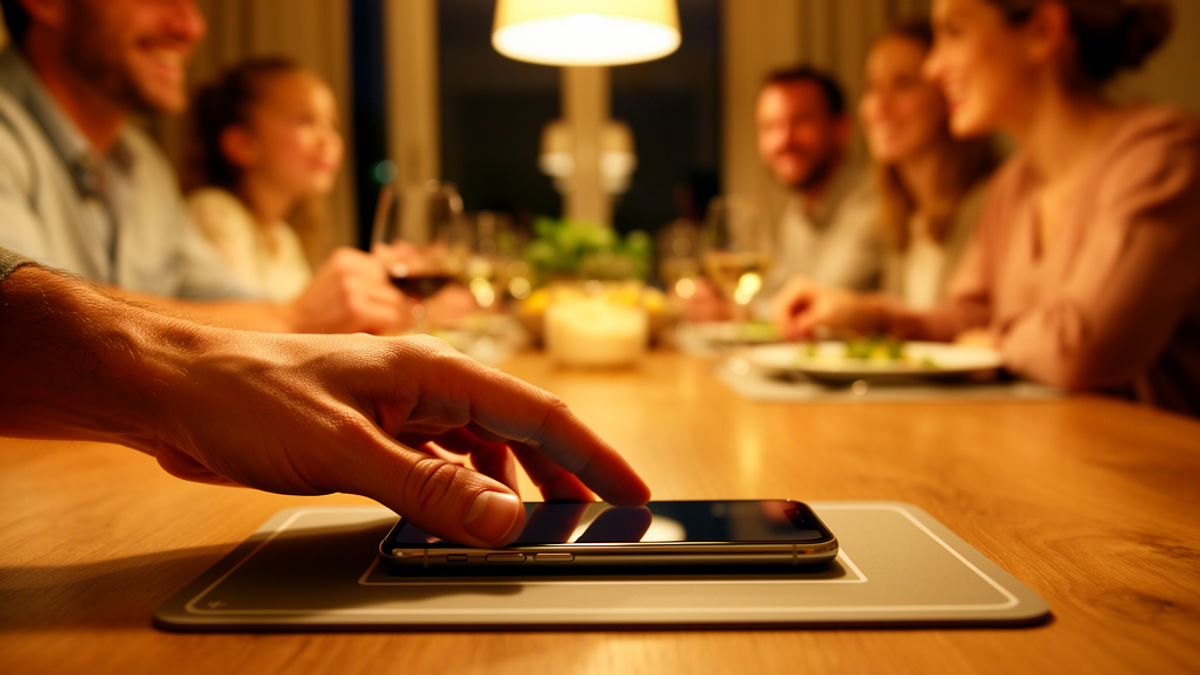
Here's how it works: When you sit down at the table—whether you're at a nice restaurant or just eating a Tuesday night family dinner at home—everyone takes their phone out, puts it on silent, and stacks it face-down in the center of the table.
The rules are simple. The first person to break and grab their phone to check a text, an email, or a sports score loses.
If you're at a restaurant, the loser has to pay the entire bill. If you're at home eating a $40 DoorDash pizza order, the loser has to pay the tip and do all the dishes. It leverages our natural American competitiveness to enforce mindfulness. You'll be amazed at how quickly people are willing to ignore a vibrating phone when there's an $85 dinner tab on the line.
Batch Your Notifications (Stop the Constant Dings)
The average American receives over 250 smartphone notifications a day. Every single ping pulls your attention away from the present moment, and it takes your brain an average of 23 minutes to fully refocus on the task you were doing.
The harsh truth is that 95% of your notifications are not urgent.
A call from your kid's school or your spouse? Urgent. A notification from Zelle that your roommate paid you $25 for the electric bill? Nice to know, but not urgent. A push alert telling you that Target is having a 20% off sale on throw pillows? Completely useless.
You don't need to be notified of everything the second it happens. Both Apple and Android have features that allow you to "batch" your non-essential notifications into a summary that delivers only once or twice a day (for example, at 8:00 AM and 6:00 PM).
Go into your settings and ruthlessly turn off notifications for social media, retail apps, and news alerts. Keep notifications on only for real people trying to reach you directly—text messages, phone calls, and maybe your calendar.
App Limits with Actual Teeth
Most of us have tried setting app time limits. You go into your settings, benevolently grant yourself 30 minutes of Instagram a day, and feel very proud of yourself.
Then, 30 minutes later, the screen locks up. What do you do? You hit the giant button that says "Ignore Limit for 15 Minutes." You do this six times in a row, completely defeating the purpose of the limit.
If you want app limits to actually work, you need to introduce social friction.
Here is the ultimate hack: Have your partner, spouse, or a trusted friend set the Screen Time passcode for you. Do not let them tell you what the passcode is.
When your 30 minutes are up, the app locks. If you genuinely need more time, you have to physically walk up to your partner, hand them your phone, look them in the eye, and ask them to type in the passcode so you can watch more dog videos. The sheer embarrassment and social friction of having to ask for permission will stop you from mindlessly scrolling 9 times out of 10.
Swap Visual Noise for Auditory Wellness
When you successfully start cutting down your screen time, you're going to notice something uncomfortable: boredom.
We use our phones as pacifiers to numb out stress, anxiety, and the mundane moments of life. When you are standing in a 10-minute checkout line at Costco and you can't pull out your phone, you might feel a spike of anxiety. When you cut out two hours of evening screen time, your house might suddenly feel very quiet.
This is where the magic happens. This is the space where genuine wellness begins.
Instead of filling that void with visual overstimulation, try swapping it for auditory wellness. At Onyx Sound Lab, we know that sound has a profound impact on the nervous system. While blue light and rapid-fire videos keep your brain in a state of fight-or-flight, the right sound frequencies can actively lower your heart rate and reduce cortisol levels.
Next time you're driving to work, instead of checking your phone at every red light, put on a grounding 432 Hz frequency track. When you're folding laundry or doing the dishes, instead of propping up a YouTube video, try listening to binaural beats. Let your eyes rest. Give your visual cortex a break and allow the healing power of sound to fill the space you've created.
Your Actionable Takeaway
Reading an article about reducing screen time on your screen is a bit ironic, isn't it? The key to making this work is not to overhaul your entire life overnight. If you try to do all of these steps at once, you'll burn out, experience digital withdrawals, and be back to doomscrolling by Tuesday.
So, here is your actionable takeaway: Pick just one thing today.
Right now, as soon as you finish reading this sentence, go into your phone's settings and turn your screen to grayscale. Try it for just 24 hours. Commit to one full day of a boring, black-and-white phone.
You might just be surprised at how beautiful and vibrant the real world looks when your digital world stops begging for your attention.

SunMaster USA
Editorial Team
The SunMaster USA team finds, tests, and shares the smartest lifehacks, money moves, and home improvement tips that make everyday life easier for American families.