The Hybrid Envelope Budget: A Modern Cash and Digital System That Actually Works
Stop stressing over your banking app. Learn how to combine old-school cash envelopes with modern digital banking to take control of your money, curb your Target spending, and build real wealth.

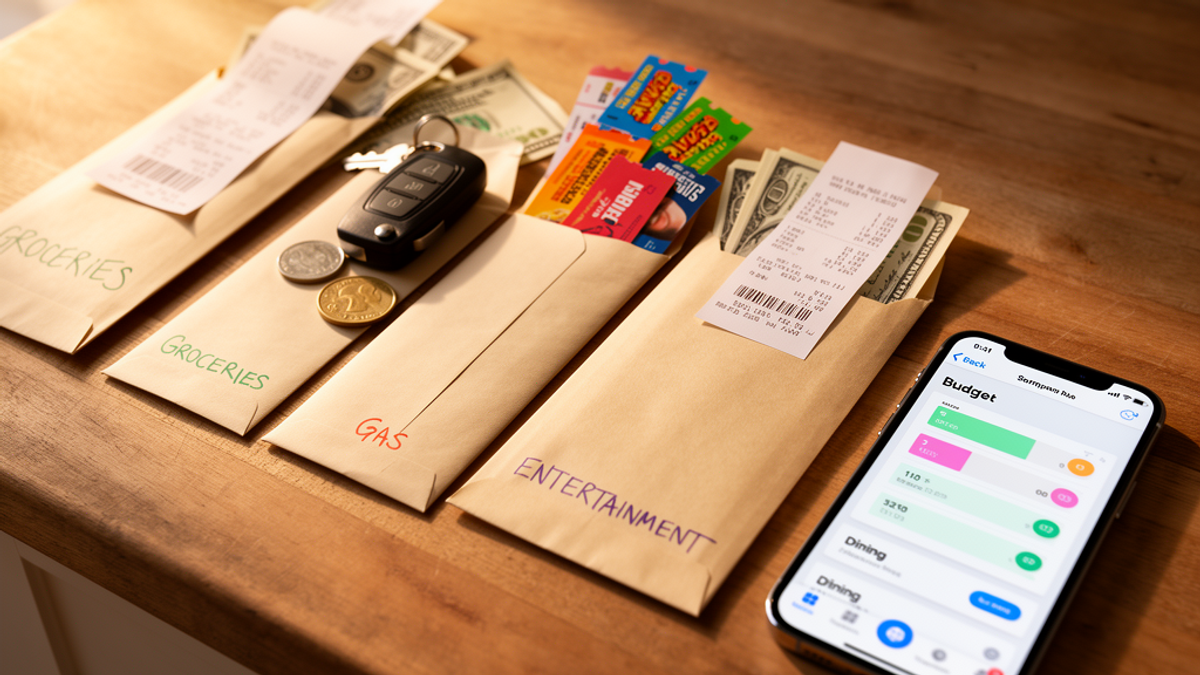
Let's be real. Checking your bank account balance shouldn't feel like bracing for a jump scare in a horror movie. Yet, for a lot of us, opening our banking app brings a sudden wave of anxiety. Financial stress is one of the biggest disruptors of our overall wellness—it messes with our sleep, spikes our cortisol, and makes it impossible to relax, no matter how many sound baths or meditation sessions we try to squeeze in.
If you've ever looked at your account on a Tuesday and wondered how you managed to spend $400 since Friday, you are not alone. It is simply too easy to spend money today. With Apple Pay, saved credit cards, and one-click checkouts, money doesn't feel real anymore. It feels like Monopoly money, right up until the credit card bill hits.
Your grandparents probably used the classic envelope budgeting system: cashing their paychecks and physically dividing the bills into paper envelopes labeled "Groceries," "Rent," and "Electric." When an envelope was empty, you stopped spending.
It's a brilliant, foolproof system. But there's a catch: It's the 21st century. You can't stuff a $100 bill into an envelope and mail it to Netflix. You can't pay your DoorDash driver in exact change through the app, and you certainly aren't walking into your mortgage lender's office with a briefcase full of twenties.
Enter the Hybrid Envelope System.
This is the modern, down-to-earth approach to budgeting that combines the psychological friction of spending physical cash with the convenience of digital automation for your fixed bills. It is designed specifically for the modern American household. Here is exactly how to set it up, category by category, so you can stop stressing and start saving.
Why the Hybrid Method Actually Works
Before we dive into the steps, we need to talk about why we are mixing cash and digital.
When you swipe a piece of plastic or tap your phone, your brain barely registers the transaction. But when you hand over a crisp $50 bill to a cashier and only get a few singles back, it hurts a little bit. Psychologists call this the "pain of paying." Cash forces you to be mindful. It puts a hard, physical boundary on your variable spending.
However, we want our fixed, recurring bills to be as painless and automated as possible. You shouldn't have to think about your car insurance or your internet bill. The hybrid method gives you the best of both worlds: strict, physical boundaries for the things you tend to overspend on, and seamless, digital automation for the things that keep your life running.
Step 1: The Digital Envelopes (Your Fixed Expenses)
Your checking account is now your "Digital Envelope." This is where your paycheck lands, and this is where your fixed, recurring expenses live.
Fixed expenses are the bills that stay roughly the same every month and can be paid online. You want to put all of these on auto-pay. By keeping these digital, you ensure you never miss a payment, never get hit with a late fee, and never have to waste a Saturday morning writing checks.
What Goes in the Digital Envelope:
- Housing: Rent or mortgage payments.
- Utilities: Water, trash, internet, and electricity. (Pro tip: if your electric bill swings wildly depending on if it's 20 degrees or 100 degrees Fahrenheit outside, call your utility provider and ask for "budget billing" to average out your monthly payments).
- Insurance: Health, car, renters, or homeowners insurance.
- Debt Payments: Student loans, car payments, minimum credit card payments.
- Subscriptions: Netflix, Spotify, gym memberships, Amazon Prime.
The Digital Buffer: Always leave a $100 to $200 "buffer" in your checking account. This protects you against minor fluctuations, like if your water bill is $10 higher than usual because you watered the lawn extra this month.
Step 2: The Cash Envelopes (Your Variable Expenses)
Here is where the magic happens. Once your fixed bills are accounted for in your checking account, you are going to go to the ATM and withdraw the rest of your budgeted money in physical cash.
Divide this cash into physical paper envelopes (or a stylish cash-stuffing binder) based on your variable spending categories. Variable expenses are the things you have control over on a day-to-day basis. This is where most American households bleed money without realizing it.
Exact Category Breakdowns for the American Household
How you divide your cash depends on your lifestyle, but here is a highly effective breakdown for a typical household, along with realistic monthly targets.
1. Groceries & Household Essentials ($600 - $900/month)
This is usually the biggest variable expense. This envelope covers your weekly Walmart or Kroger runs, as well as your bulk trips to Costco or Sam's Club.
- The Strategy: When you walk into Costco with a cart, it's dangerously easy to walk out with a $400 receipt because you "needed" a kayak and a 5-pound tub of pretzels. If you only bring your $150 cash envelope for the week's groceries, you are forced to stick to your list. Put the rotisserie chicken in the cart, skip the oversized electronics, and pay with cash.
2. Dining Out & Convenience ($150 - $300/month)
This envelope is for Friday night pizza, grabbing a $6 latte on the way to work, or hitting the drive-thru.
- The Strategy: We all love the convenience of DoorDash, but the fees and tips can easily add $15 to a $20 meal. If you want takeout, use the cash in this envelope to go pick it up yourself. When this envelope is empty, it means you are eating leftovers or making spaghetti at home until your next payday.
3. Gas & Transit ($150 - $250/month)
Unless you work from home, you are likely putting a lot of miles on your car commuting.
- The Strategy: Keep this envelope in your glovebox. When you pull up to the pump, walk inside and hand the cashier your cash. It prevents you from mindlessly buying a Red Bull and a bag of chips at the pump, because you only brought exactly enough cash for the fuel.
4. The "Target Trap" / Fun Money ($100 - $200/month)
Everyone needs a little sanity money. This is guilt-free cash you can spend on whatever you want.
- The Strategy: We call this the "Target Trap" because we all know the danger of walking into Target for paper towels and leaving with $85 worth of candles, throw pillows, and things from the Dollar Spot. If you have $50 of Fun Money in your pocket, you can buy the candle guilt-free. When the $50 is gone, you walk right past the home decor aisle.
5. Home & Auto Maintenance ($50 - $100/month)
Things break. You need oil changes, air filters, or a bag of mulch for the front yard.
- The Strategy: Use this cash for those Saturday morning trips to Home Depot or Lowe's. If you don't use it all one month, let the cash roll over and build up for when you inevitably need a larger repair.
Step 3: Handling Digital "Variable" Spending
"But wait," you might be thinking, "what if I need to buy something online? Or what if I need to Venmo my friend $30 for my half of the dinner bill?"
This is the most common roadblock people hit with the envelope system, but the solution is incredibly simple. It's called the Receipt Swap Method.
Let's say you are out with friends, and your buddy pays the tab with his credit card. You need to Zelle or Venmo him $40.
- Send him the $40 through the app (this money comes out of your digital checking account buffer).
- When you get home, take $40 in physical cash out of your "Dining Out" envelope.
- Next time you go to the ATM to pull out cash for your next paycheck, deposit that $40 back into your checking account to replenish your buffer.
Similarly, if you buy a $30 shirt on Amazon, pay with your debit card online, take $30 out of your "Fun Money" envelope, and deposit it back into the bank later. It keeps your budget perfectly balanced without sacrificing the convenience of the modern internet.
Step 4: Digital Sinking Funds (Your Secret Weapon)
To truly master your money and reduce financial anxiety, you need to plan for the expenses that don't happen every month, but happen every year. Think: Christmas gifts, annual property taxes, car registration, or a summer vacation.
These are too large to keep in cash envelopes under your mattress. Instead, use Digital Sinking Funds.
Open a High-Yield Savings Account (HYSA) that allows you to create "buckets" or sub-accounts. (Many modern online banks offer this feature). Treat these buckets like digital envelopes.
If you know you want to spend $600 on holiday gifts in December, don't wait until November to panic. Divide $600 by 12 months. Set up an automatic transfer of $50 a month from your checking account into your "Christmas" digital envelope. When December rolls around, the money is just sitting there, waiting for you. No credit card debt required.
Troubleshooting the System
What do I do with all the loose change? Don't carry it around. Get a large mason jar and drop all your coins into it at the end of the day. You'd be surprised how fast this adds up. Once a year, take it to a coin-counting machine or roll it up for the bank. It's essentially a free bonus envelope!
What if an envelope runs out, but I really need something? You have two choices. You can either wait until your next payday (building discipline), or you can "borrow" from another envelope. If you ran out of Grocery money but you still have $40 in your Fun Money envelope, you can move that cash over to buy food. But once the cash across all envelopes is gone, spending completely stops.
Isn't carrying cash dangerous? You don't need to carry all your envelopes with you at all times. If you are just going to work, maybe you only take your "Gas" and "Dining Out" envelopes. Leave the rest safely at home in a locked drawer or a fireproof box.
The Takeaway: Your Action Step for Today
Financial wellness isn't about restricting yourself until you're miserable; it's about creating boundaries so you can spend your money stress-free. When you know all your bills are paid and you have $100 in your pocket specifically dedicated to having fun, you can actually enjoy that money without the looming dread of buyer's remorse.
Here is your actionable step for today: You don't have to overhaul your entire financial life in one afternoon. Start small. Pick your biggest "problem" category—the one where your money just seems to vanish. For most people, this is dining out or impulsive Target runs.
Look at your budget, decide on a reasonable amount for the next two weeks (let's say $100), and go to the ATM today. Put that $100 in a physical envelope. For the next 14 days, you are not allowed to swipe your card for that category. When the cash is gone, it's gone.
Try it for just two weeks. You'll be amazed at how quickly your mindset shifts, how much money you save, and how much lighter you feel when you finally take the steering wheel back from your banking app.

SunMaster USA
Editorial Team
The SunMaster USA team finds, tests, and shares the smartest lifehacks, money moves, and home improvement tips that make everyday life easier for American families.